

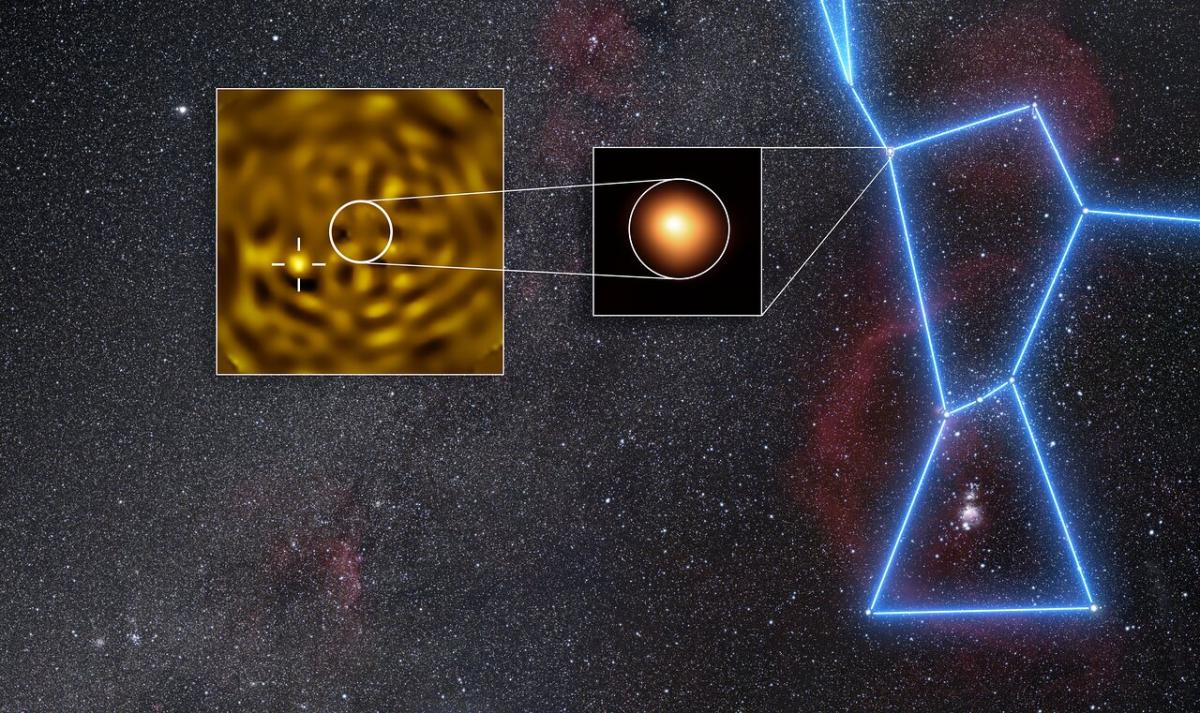
After more than a century of searching, astronomers have confirmed Betelgeuse's elusive companion star, and AAVSO observations played a critical role in the discovery. | By Tom Calderwood
AAVSO observers Tom Calderwood and Pam Morgan-McKee are co-authors on a new paper by Montargès et al. (2026) reporting the first high-confidence direct detection of Siwarha, the long-suspected companion to Betelgeuse. Since 2018, members of the AAVSO Photoelectric Photometry (PEP) Special Interest Group have monitored Betelgeuse with high-precision V-band observations. Those measurements were used to constrain models of Betelgeuse's changing brightness, allowing astronomers to separate the light of the red supergiant from that of its much fainter companion.
Miguel Montarges, lead author of the paper, comments, "In this study, we identify the nature of Betelgeuse B using its observed flux. More precisely the processing gives us the contrast between Betelgeuse B (the companion) and A (the primary). A curious problem is that Betelgeuse A, the well-known red supergiant, is a variable star. Only the AAVSO is capable of delivering the magnitude of such a star at any given date, allowing us to derive the brightness of Betelgeuse B and to infer its nature. This is another example of how valuable observations made by those we still improperly call 'amateur' astronomer are. I would like to take this opportunity to express my deepest thanks to this community that performs such a remarkable work."
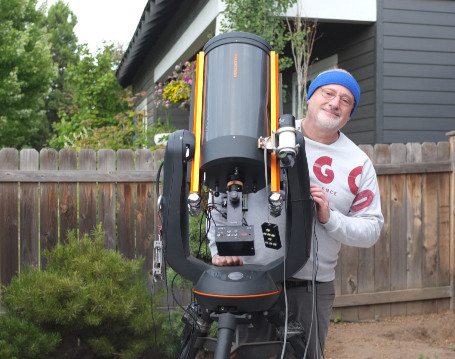
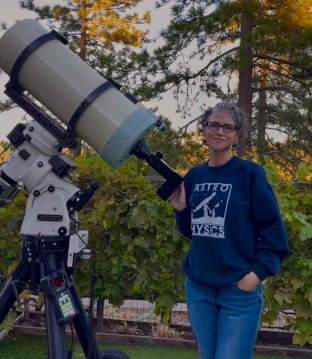
AAVSO observers and co-authors Tom Calderwood (left) and Pam Morgan-McKee (right) with the telescopes and Optec SSP-3 photoelectric photometers used to monitor Betelgeuse. Their observations helped enable the first high-confidence detection of the star's long-suspected companion.
The discovery highlights the unique role that long-term monitoring by AAVSO observers plays in modern astronomy. While large observatories can obtain extraordinarily detailed images, they often rely on the AAVSO's continuous photometric record to understand how variable stars are behaving at the moment those observations are made.
The Optec SSP-3 photoelectric photometers used by the AAVSO PEP Section are particularly well suited for observing very bright stars such as Betelgeuse. PEP observations have previously been cited in studies led by Andrea Dupree of the Center for Astrophysics and supported recent Hubble Space Telescope observing proposals. During Betelgeuse's dramatic "Great Dimming" in 2019-2020, AAVSO observers provided an important record of the star's changing brightness, work later featured in Sky & Telescope and presented at the 2021 Cambridge Workshop on Cool Stars.
The PEP group is presently ramping up a project on very bright alpha Cygni stars including Deneb itself (see page 15 of the 114th AAVSO Annual Meeting proceedings). We need additional observers for this effort. Though SSP photometers are no longer manufactured there are many gathering dust in college, high school, and private observatories. If you do not have a photometer, ask around and you may find one (we also have a few loaner units available). Participants outside of North America would be especially welcome. The photometers are easy to use and we can help with training. PEP campaigns would be a great activity for students.
If you're interested in getting involved, visit the AAVSO PEP forum and consider joining the PEP Special Interest Group to learn more, connect with experienced observers, and join current observing campaigns.